Start with a visual promise, not a list of shots.
A bold graphic narrative with iconic angles, readable action and an animated finish.
The workflow turns one controlled creative brief into a complete storyboard sheet. Each scene advances the same story while the character bible, palette, recurring objects and environment references keep the visual world coherent.
Comic artists, motion-comic teams and campaign illustrators.
Reduce the premise to a protagonist, a visual threat and one decisive image.
Why a strong storyboard changes the final result.
Graphic storytelling lives or dies by silhouette and hierarchy. A storyboard proves that action reads before detail, texture or captions are added.
A storyboard is not a contact sheet of attractive images. It is the cheapest place to solve narrative logic, direct attention and test continuity before those decisions become expensive animation problems. It gives every collaborator the same definition of the story: what the audience knows, what changes in each shot and which visual facts must never drift.
What weak boards get wrong
Using the same medium camera distance throughout, creating a visually flat sequence with no emphasis.
Build meaning across cuts
Treat shot scale like typography: wide shots are paragraphs, close-ups are bold words and the final iconic frame is the headline.
Convert all eight panels to black silhouettes. Rework any panel whose subject or action becomes ambiguous.
Configure the workflow before generating.
Choose a focused premise
Reduce the premise to a protagonist, a visual threat and one decisive image.
Build the subject and world
Choose ink language, color script, hero silhouette, setting and action density.
Lock continuity rules
Lock line weight, costume blocks, key props and the direction of movement.
Set the directing logic
Vary panel scale aggressively while preserving geography and cause-and-effect.
Reserve your highest-contrast color pairing for the decisive action panel.
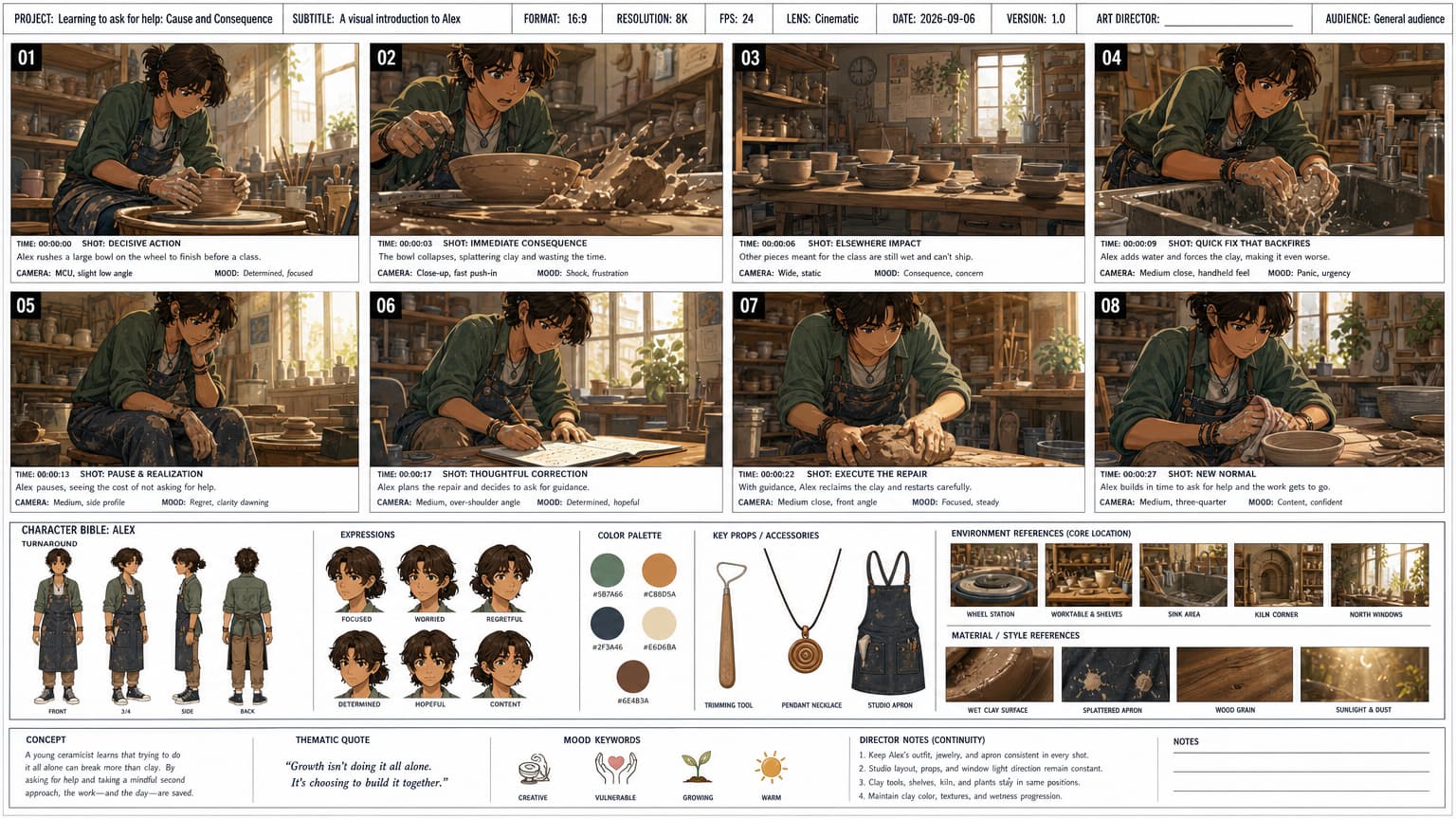
Make every frame perform a different job.
Shots 01–02 · Establish
Introduce the world, protagonist and immediate visual question. Move from a readable wide shot to one meaningful detail.
Shots 03–04 · Reveal the goal
Clarify what must change, then show the object, relationship or obstacle that makes the goal specific.
Shots 05–06 · Turn the story
Show consequence and realization. This pair should change the protagonist’s understanding, not merely repeat the action.
Shots 07–08 · Act and resolve
Deliver the decisive action and a final image that proves the emotional or practical outcome.
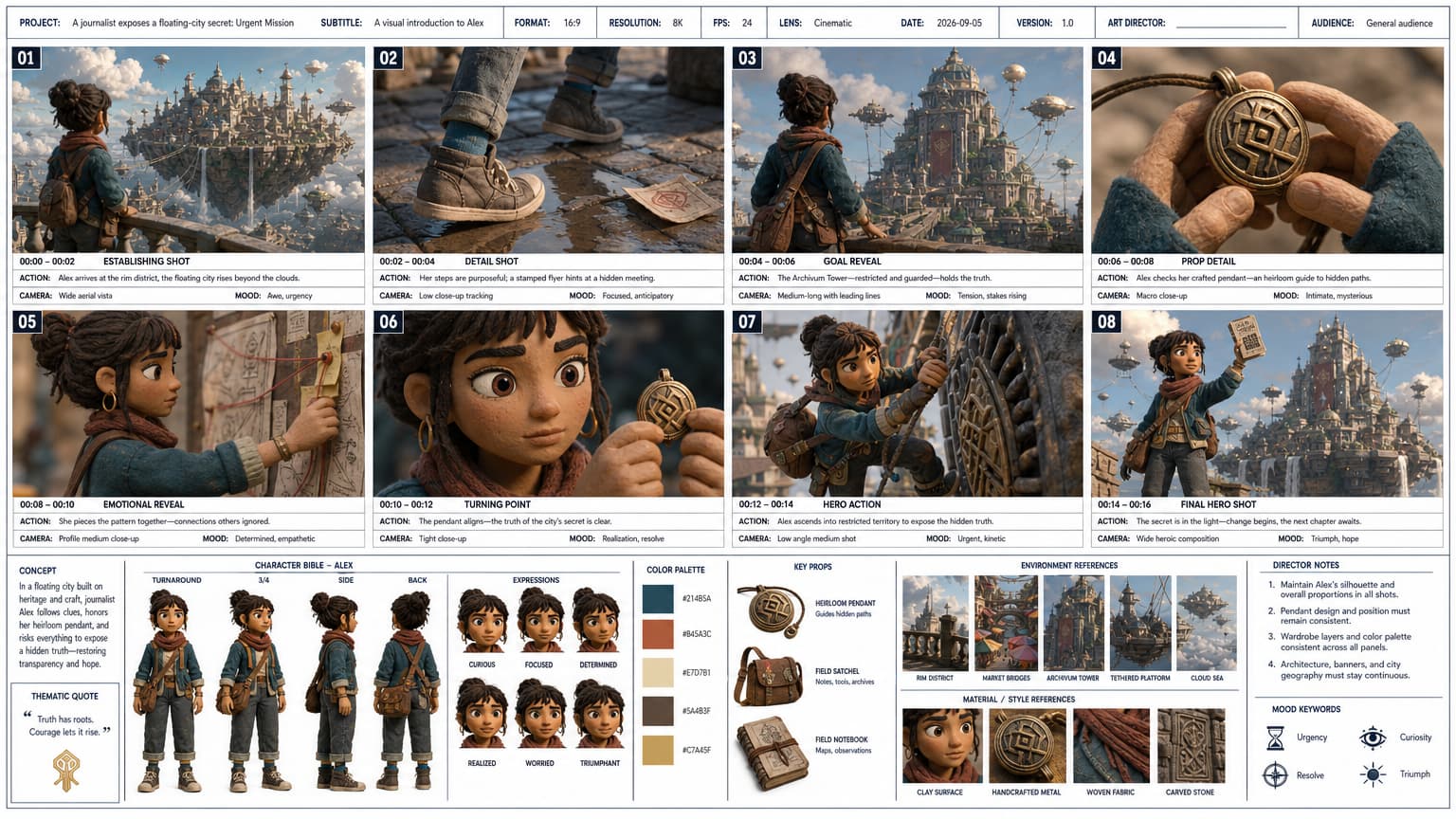
Review the sheet before animation.
Ensure the story reads without captions or speech bubbles.
- The protagonist, wardrobe and defining features match in all eight scenes.
- Every shot advances the story and uses a purposeful camera scale.
- Props, geography, lighting and visible consequences remain continuous.
- The final frame resolves the premise and provides a strong animation source.
- No accidental text, duplicated anatomy or unexplained artifact appears in the sheet.
Once the storyboard is approved, open the video step, select the intended motion quality and send the reference image to Seedance 2.0. Keep the animation prompt focused on movement, camera behavior, timing and sound rather than redesigning the scene.
Build this storyboard.
Open the configured workflow and turn your premise into eight production-ready scenes.